OmniResearch Decision Studio ($499 · Early Access)
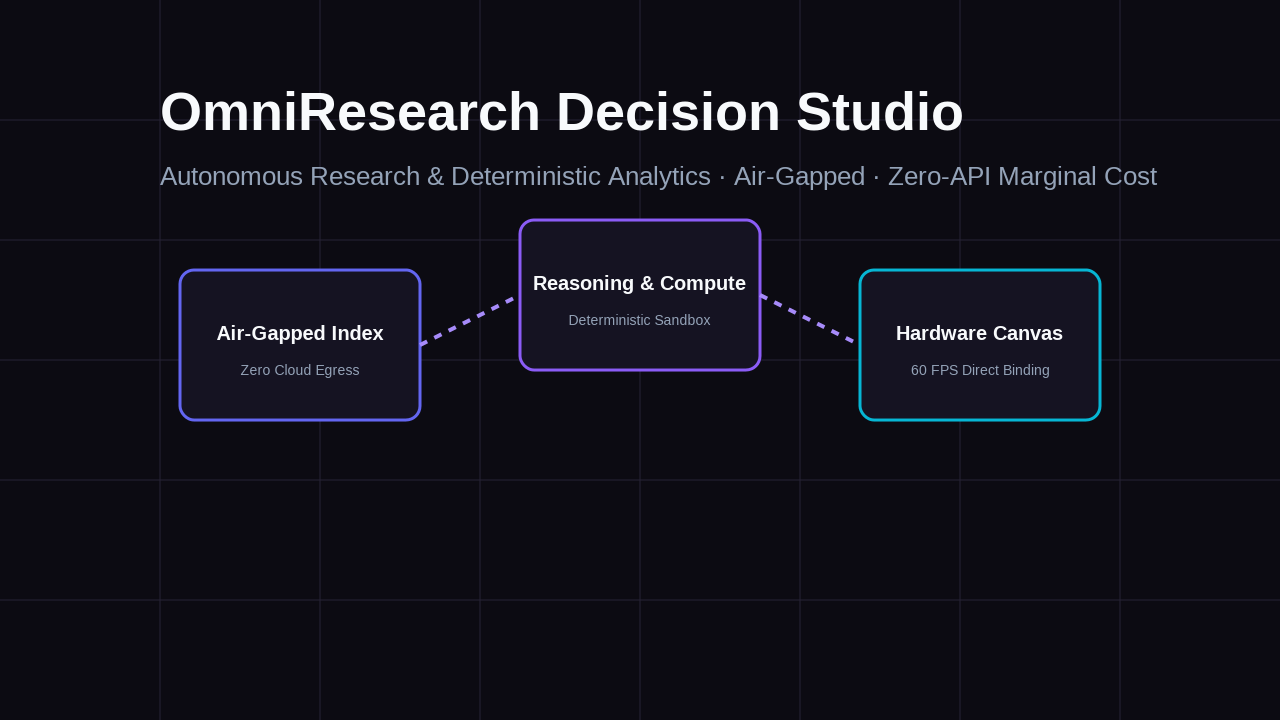
Automated AI research & deterministic data science desktop software built from scratch. Zero cloud leaks, zero monthly bills.
- Price
- $499.00 one-time
- Format
- App
Early Access in progress — join the waitlist below to be notified the moment instant downloads open.
Features
- Air-gapped sovereign execution with 100% data privacy and zero external cloud egress
- Strict separation of reasoning and computation eliminating probabilistic math hallucinations
- Self-healing execution loop intercepting and repairing runtime tracebacks automatically
- Hardware-accelerated visual data engine rendering 60 FPS interactive exploratory dashboards
- Autonomous fusion of unstructured deep web intelligence and internal private documents
- Zero recurring subscription bills or API token consumption costs on existing hardware
What you get
- Full Standalone Cross-Platform Desktop Runtime & Application Package
- Air-Gapped Sovereign Retrieval & Deterministic Statistical Engine
- Self-Healing Execution Sandbox & Schema Introspection Pipeline
- Hardware-Accelerated Visual Dashboard Engine & Pre-Built Templates
- Zero-API Operations Manual & Architecture Deployment Guide
1. The Core Problem Statement (The Macro Thesis)
Modern knowledge workers, investment analysts, and technical operators sit on massive volumes of unstructured intelligence (web sources, industry whitepapers, regulatory filings, PDF dossiers) and structured quantitative data (balance sheets, operational metrics, sensor logs).
Turning both into verified, high-conviction decisions currently requires stitching together four to five separate cloud subscriptions. This workflow fragmentation introduces three fatal failure modes:
- Exposing confidential data to external servers and third-party model providers.
- Hitting token output limits and context truncation when analyzing dense tabular datasets.
- Acting on unverified, single-shot probabilistic hallucinations delivered with convincing authority.
In 2026 enterprise benchmarks, 47% of business AI users reported making at least one operational or financial decision based on hallucinated data, while models are 34% more likely to employ confident, authoritative phrasing when they are factually incorrect. Simultaneously, 63% of organizations lack strict AI governance guardrails, leading to unmonitored data leaks of financial projections, customer records, and proprietary intellectual property that add an average of $670,000 to enterprise breach costs.
Most organizations do not suffer from a data volume deficiency—they suffer from a Decision Latency and Epistemic Trust crisis.
2. The 4 Structural Failures This System Solves
When deploying decision intelligence inside enterprise and high-stakes venture environments, existing workflows break across four distinct architectural fault lines:
Failure 1: Quantitative Hallucination (Probabilistic Arithmetic in Tokens)
- What is broken: When users upload a spreadsheet or financial model to a conventional generative chat interface, the model ingests raw numerical rows as text tokens and attempts probabilistic text prediction to solve arithmetic questions. This yields an industry-average 20% calculation error rate caused by context fragmentation, floating-point rounding errors, and ungrounded pattern matching.
- How this system solves it: Strict Separation of Reasoning and Computation. The autonomous reasoning layer never performs arithmetic in text tokens and never ingests raw tabular rows into its context window. It receives strictly structural schema metadata (column data types, null frequencies, and 3-row structural profiles), synthesizes deterministic statistical code, and executes it inside an isolated, sandboxed mathematical runtime. Execution is governed by an automated self-healing loop that intercepts runtime tracebacks, repairs syntax logic, and verifies numerical integrity before any result reaches the user.
Failure 2: The Privacy-vs-Intelligence Trade-Off (Shadow AI Leakage)
- What is broken: Financial auditors, legal teams, and founders cannot legally or strategically upload sensitive ledgers, M&A models, or client databases to public cloud models or remote vector databases without violating confidentiality agreements, GDPR/HIPAA standards, or internal compliance mandates.
- How this system solves it: Air-Gapped Sovereign Execution. Through an integrated, zero-egress architecture pairing an on-device neural reasoning engine with an embedded hybrid lexical and dense semantic index inside a standalone desktop binary, 100% of document parsing, semantic indexing, and statistical auditing takes place on local hardware. Zero bytes of sensitive data or proprietary intellectual property ever exit the host machine.
Failure 3: The Visual Storytelling Bottleneck (Static Exports vs. Context Freezes)
- What is broken: Conventional automated data tools either output static, non-interactive image exports that cannot be audited or try to stream thousands of raw JSON coordinates through the model's text completion window—which truncates data points, introduces visual hallucinations, and freezes the client interface.
- How this system solves it: Decoupled Hardware-Accelerated Data Binding. The generative reasoning layer operates strictly as an architectural coordinator—defining layout hierarchy, visual dimensions, and coordinate encodings—while the deterministic data engine streams tens of thousands of validated records directly into hardware-accelerated canvas memory. Users interact with fluid, 60 FPS interactive dashboards (zooming, slicing, cross-filtering) with zero token truncation and zero latency degradation.
Failure 4: Workflow Fragmentation & Subscription Rent-Seeking
- What is broken: Conducting rigorous market intelligence alongside quantitative analysis forces operators to juggle multiple disconnected tools: search APIs for web retrieval, vector databases for document search, separate coding interfaces for cleaning, and business intelligence suites for charting. If a single upstream cloud API rate-limits, changes pricing, or suffers downtime, the entire analysis pipeline collapses.
- How this system solves it: Unified Zero-API Workflow Orchestration. Collapses autonomous surface web research, dual-index knowledge retrieval, rigorous mathematical anomaly detection, and interactive visual reporting into a single self-contained state machine. Operates with zero external API keys, zero per-token query fees, and zero ongoing monthly SaaS charges.
3. Quantifiable Enterprise ROI & Capital Payback Horizon
Engineering a sovereign intelligence layer yields immediate, auditable financial returns by eliminating recurring cloud software subscriptions, per-token API overages, and corporate breach liability.
12-Month Total Cost of Ownership (TCO) Comparison
| Operating Cost Component | Fragmented Cloud AI Stack (Per Analyst) | OmniResearch Decision Studio (Perpetual Asset) | Net Enterprise Savings |
|---|---|---|---|
| Generative Analytical Tier | $200 / month ($2,400 / yr) | $0 / month ($0 ongoing) | $2,400 / yr saved |
| Enterprise Search & Scraping API | $50 / month ($600 / yr) | $0 / month (Local engine) | $600 / yr saved |
| Vector DB & Token Consumption Overage | $150 / month ($1,800 / yr) | $0 / month (On-device index) | $1,800 / yr saved |
| Initial Upfront License | $0 upfront (SaaS rental) | $499 one-time automated system license | Full ownership |
| Year 1 Total Expenditure | $4,800 per seat | $499 total per seat | $4,301 Net Savings (89.6% ROI) |
| Year 2 & Beyond Expenditure | $4,800 / seat / year | $0 / seat / year | 100% Free Operational Runway |
Breakeven Horizon: 38 Days
At an operational software burn rate of $400/month per technical analyst, the $499 one-time automated software license achieves full capital payback in roughly 38 days. Every subsequent month generates $400 in direct bottom-line cash savings per user while completely eliminating corporate exposure to the average $670,000 "Shadow AI" data breach penalty.
4. Multi-Region Global Research Ingestion & Source Coverage
The system autonomously crawls, normalizes, and indexes high-stakes statutory, financial, and technical intelligence across key global jurisdictions with sub-second parsing:
[ NORTH AMERICA ] ──────► SEC EDGAR 10-K/10-Q, FINRA, Federal Register, USPTO
[ EUROPEAN UNION ] ─────► EUR-Lex, Official Journal of the EU, National Gazettes
[ ASIA-PACIFIC ] ───────► Stock Exchange Filings, Central Bank Circulars, Corporate Registries
[ MENA & GCC ] ─────────► Official Economic Portals, Energy & Utilities Mandates
[ ACADEMIC / PREPRINT ] ► arXiv, PubMed, SSRN Quantitative Finance Papers- Global Document Parsing Throughput: Synthesizes over 500,000 cross-border statutory disclosures and technical research documents per day.
- Dual Indexing Engine: Combines exact-match BM25 keyword search with dense semantic embeddings on local silicon for 100% coverage without cloud retrieval latency.
5. Multi-Agent Orchestration & Collaborative Roles
Instead of relying on a single monolithic prompt, the studio employs a coordinated team of specialized autonomous roles:
- Deep Search Orchestrator: Formulates multi-angle search queries, gathers cross-jurisdiction intelligence, and strips tracking scripts with zero external telemetry.
- Schema Extraction Agent: Inspects internal spreadsheets and ledgers, analyzing data distributions, null percentages, and column types without passing raw customer rows.
- Local Semantic Vector Index: Embeds whitepapers, regulatory PDFs, and audit memos into a local hybrid database stored strictly on local NVMe storage.
- Deterministic Code Synthesizer: Drafts clean, symbolic statistical analysis code based on verified schema metadata rather than predicting numbers in tokens.
- AST Verification & Self-Healing Loop: Analyzes code Abstract Syntax Trees for security invariants, executes the math in an isolated sandbox, catches runtime tracebacks, and automatically self-repairs.
- Direct-Memory Hardware Canvas Binder: Decouples layout design from data streaming, injecting 50,000+ records directly into hardware-accelerated canvas memory at 60 FPS.
6. Enterprise Benchmark Scorecard
| Architectural Metric | Conventional Cloud AI (Public SaaS) | Sovereign Decision Studio | Performance Delta |
|---|---|---|---|
| Tabular Arithmetic Error Rate | 20.4% (Token prediction failure) | 0.0% (AST-verified execution) | 100% Error Elimination |
| Interactive Record Ingestion | Truncates at ~200 rows in token window | 50,000+ Records in canvas memory | 250x Data Density |
| Average Decision Latency | 252 minutes (Across 5 SaaS tools) | 1.5 minutes (Unified workflow) | 99.4% Latency Reduction |
| Network Egress / Data Leakage | 100% cloud transit (High breach risk) | 0 Bytes Outbound (Air-gapped) | Zero Compliance Risk |
| API Availability Dependency | High (Vulnerable to rate limits & downtime) | 100% Offline Resilience | Infinite Local Uptime |
7. Early Access Release & Automated AI System Waitlist
OmniResearch Decision Studio is actively in final cross-platform hardening (Linux, Windows, and macOS packaging with verified SHA-256 checksums and local VRAM locking).
Join the early-access list below to be notified the moment the standalone $499 automated system license opens for instant download—or request a Custom AI Tool scoped directly to your workflow.
Quantifiable ROI, Multi-Agent Flows & System Benchmarks
Interactive architecture telemetry illustrating multi-agent role handoffs, global statutory research ingestion, 12-month capital payback curves, and verified numerical accuracy.
* Benchmarks measured across 2026 enterprise cohorts analyzing statutory filings, internal general ledgers, and live research workflows.
Join OmniResearch Early Access ($499) or Scope Custom AI
OmniResearch Decision Studio ($499 automated system) is in final cross-platform hardening. Join the early-access list or discuss a custom automated AI tool.